Metal-ion Batteries

  1. Home
  2. »
  3. Sodium Lithium ion Battery

Metal-Ion Batteries

Our research is directed toward the development of advanced electrode materials for high-energy-density and high-stability lithium-ion and sodium-ion batteries, with the broader goal of realizing safe, durable, and sustainable energy storage technologies. We aim to achieve improved specific capacity, rate capability, cycling life, and interfacial stability through rational materials design and electrochemical engineering. For sodium-ion batteries, we primarily focus on cathode materials such as Prussian Blue/Prussian Blue Analogues (PB/PBAs) and Na3V2(PO4)3 (NVP), which are attractive due to their open frameworks, fast ion transport, and structural stability. Our goal is to enhance their electrochemical performance and long-term durability by addressing key issues related to defects, conductivity, and structural degradation.

For lithium-ion batteries, our work centers on alloy-type anode materials with high theoretical capacities, including Si-, Sn-, and Sb-based systems. We aim to overcome challenges associated with volume expansion and poor cycle stability through the design of nanostructured, composite, and interface-engineered anodes.

.

Metal-ion batteries

Designing robust electrodes for lithium-ion and sodium-ion batteries, with a focus on capacity, rate capability and long-term stability.
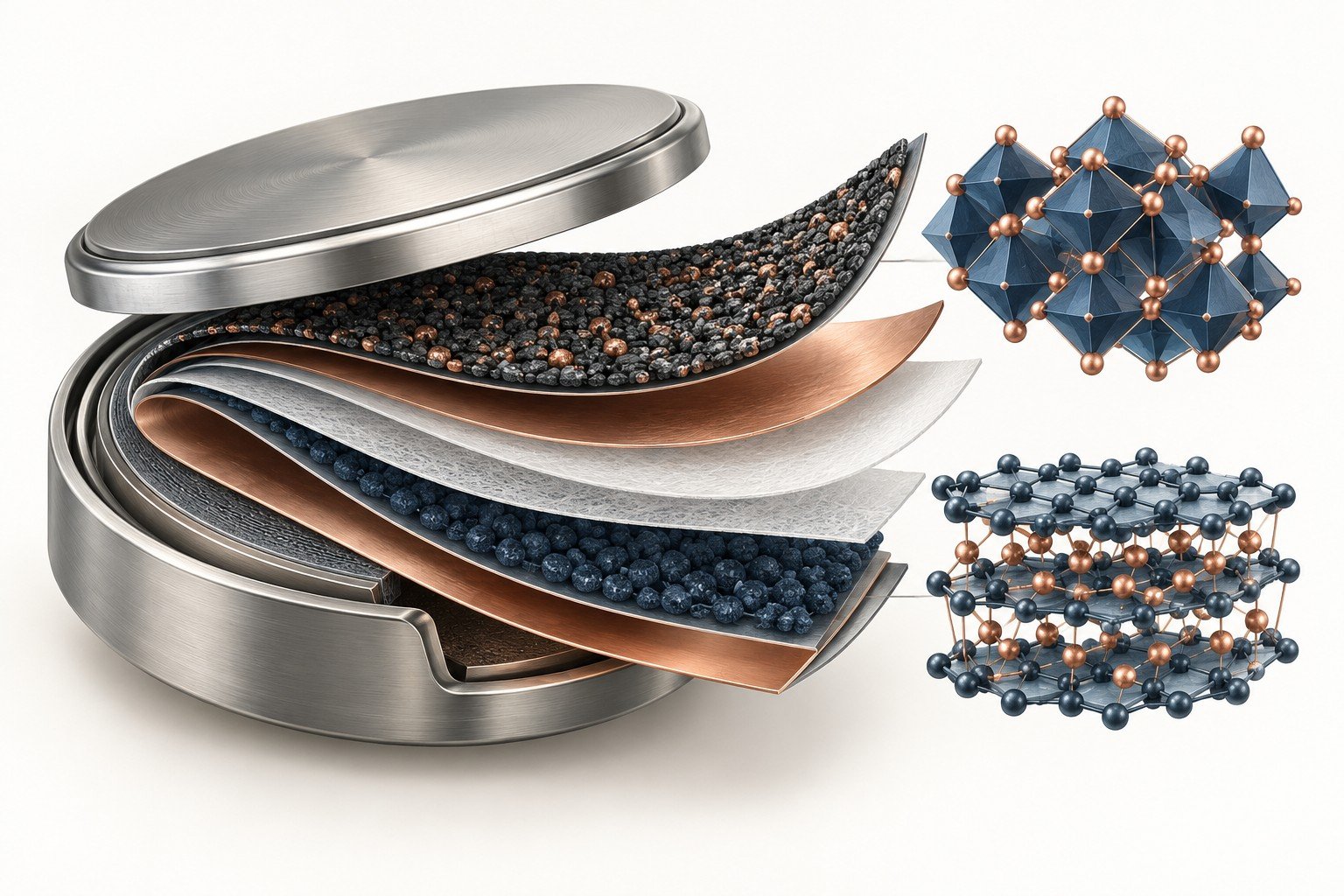
Conceptual illustration of metal-ion batteries
Conceptual research illustration
Research direction

Our approach

Our work connects materials design with electrochemical engineering to address the structural and interfacial challenges that limit rechargeable batteries.

01

Sodium-ion cathodes

Prussian Blue and its analogues, alongside Na₃V₂(PO₄)₃, provide frameworks for investigating ion transport, defects and structural stability.

02

Lithium-ion anodes

Si-, Sn- and Sb-based alloy systems are explored through nanostructured and composite designs that address volume changes during cycling.

03

Stable interfaces

Interface engineering and improved conductivity guide our efforts to reduce degradation and extend electrode durability.

What we aim to achieve

Balance energy storage, rapid charge transfer and durable cycling through rational electrode and interface design.