Multivalent Aqueous-Ion Batteries

  1. Home
  2. »
  3. Multivalent Aqueous-Ion Batteries

Multivalent Aqueous-Ion Batteries (Li⁺, Na⁺, Zn²⁺, Al³⁺)

Our research is directed toward the development of multivalent and aqueous-ion batteries, including Zn-, Al-, Na-, K-, and related aqueous rechargeable battery systems, for safe, low-cost, and sustainable energy storage applications. These battery technologies offer significant advantages such as high safety, environmental compatibility, fast ion transport, and practical scalability. We focus on the design of advanced cathode, electrolyte, and anode materials to achieve high energy density, high capacity, and ultra-stable electrochemical performance. In particular, our work emphasizes the development of robust cathode materials with improved structural stability, ion-storage capability, and cycling durability under aqueous operating conditions. We are also actively engaged in electrolyte engineering to regulate ion transport and improve electrode–electrolyte interfacial stability, which is essential for enhancing battery efficiency and long-term performance. On the anode side, we work on strategies to stabilize metal electrodes, suppress dendrite formation, corrosion, and parasitic side reactions, and improve reversibility and cycling life in aqueous battery systems.

Aqueous-ion batteries

Exploring water-based rechargeable batteries through coordinated design of cathodes, electrolytes and metal anodes.
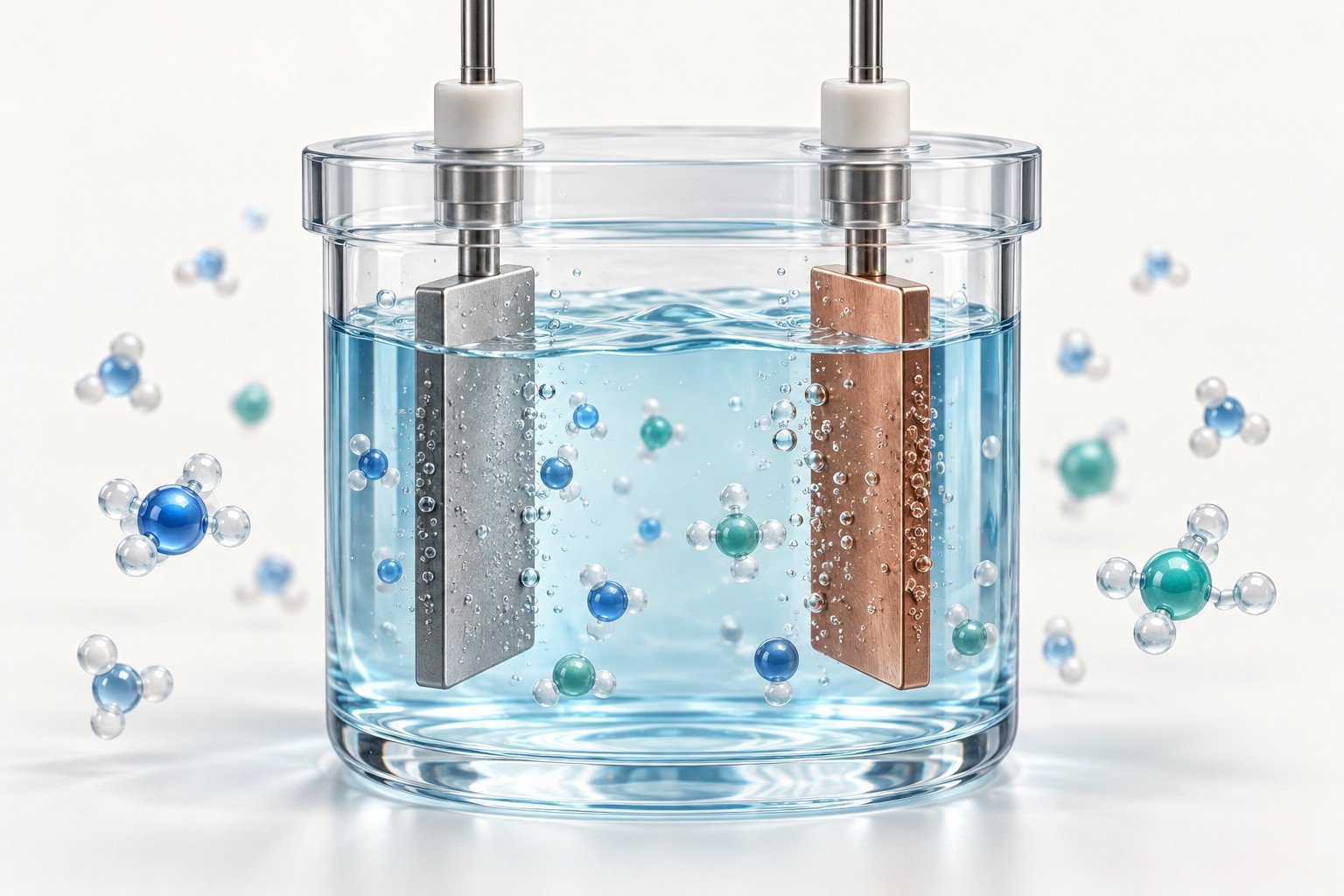
Conceptual illustration of aqueous-ion batteries
Conceptual research illustration
Research direction

Our approach

Our research includes multivalent zinc and aluminium systems as well as monovalent sodium and potassium aqueous systems. We investigate the materials and interfacial processes that enable reversible storage under aqueous conditions.

01

Robust cathodes

We study electrode structures that support ion storage while addressing structural degradation and dissolution.

02

Electrolyte engineering

Electrolyte composition and electrode–electrolyte interactions offer routes to improve transport and cycling reversibility.

03

Metal-anode stability

We investigate dendrites, corrosion and parasitic reactions to understand and improve metal-anode behaviour.

What we aim to achieve

Advance durable, cost-conscious aqueous energy storage by understanding reaction mechanisms and stabilizing interfaces.