Hybrid Capacitors
- Home
- »
- Supercapacitors
Hybrid capacitors
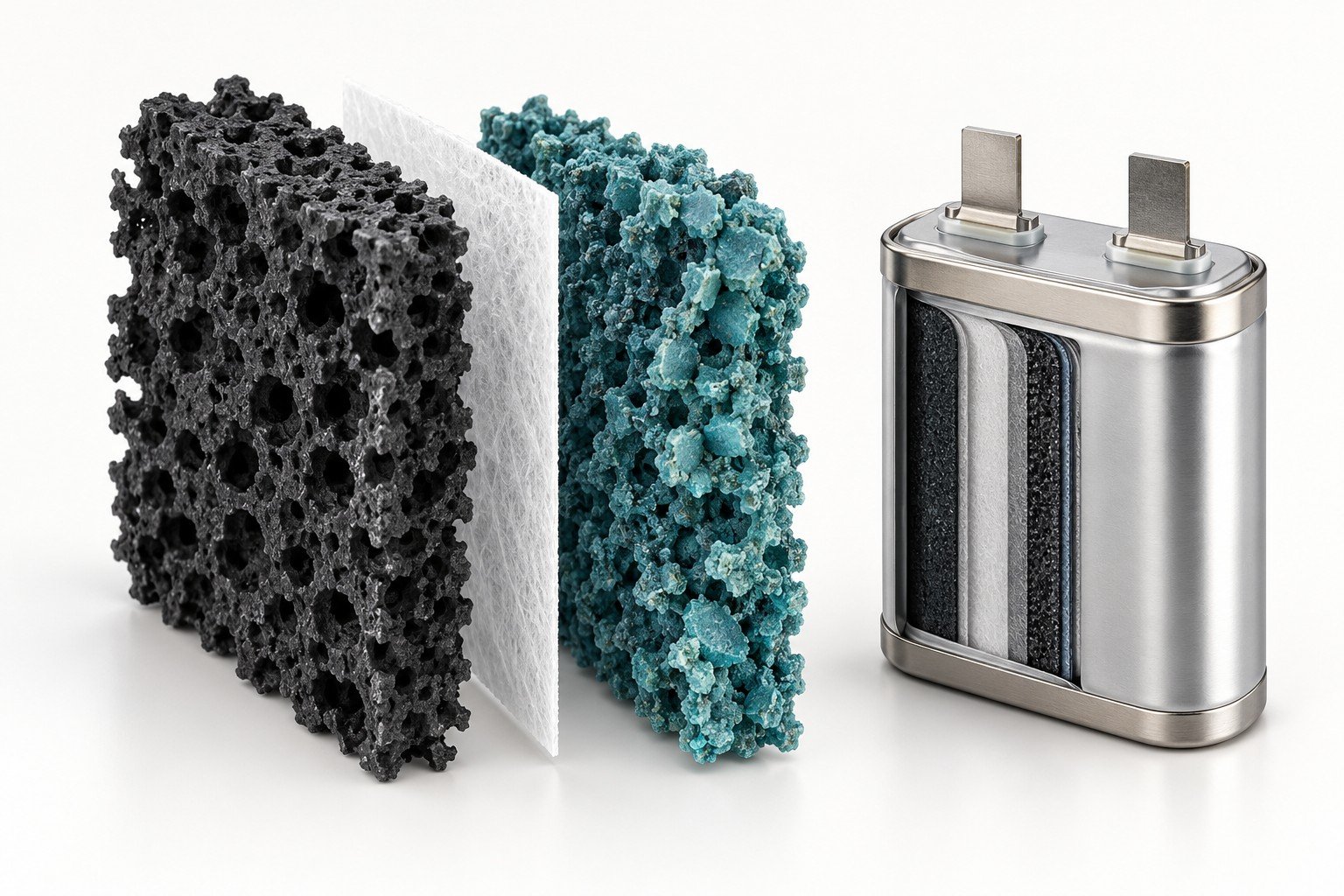
Our research is directed toward the development of advanced electrode materials and device architectures for high-performance supercapacitors, with a focus on achieving high energy density, high power density, and ultra-long cycling stability. Supercapacitors offer unique advantages such as rapid charge-discharge capability, high reliability, and extended operational life, making them attractive for next-generation energy storage systems. We focus on the design and synthesis of functional electrode materials, including carbon-based materials, transition metal oxides/sulfides, and hybrid nanocomposites, to enhance charge storage mechanisms and electrochemical performance. Through nanostructure engineering, defect tuning, and interface design, we aim to improve electrical conductivity, ion transport kinetics, and structural integrity. We also explore electrolyte engineering and device configuration, including symmetric and asymmetric systems, to optimize energy-power balance and long-term stability.
Hybrid capacitors
Developing electrode materials and device architectures that combine rapid charge delivery with durable energy storage.
Our approach
Our work explores functional carbons, transition-metal oxides and sulfides, and hybrid nanocomposites. We connect materials structure and interfacial behaviour with electrochemical response.
Functional electrodes
We design porous carbons and redox-active materials to provide accessible sites for charge storage.
Structure and interfaces
Defect engineering, conductivity and transport pathways guide the design of hybrid electrode architectures.
Device configurations
Symmetric and asymmetric configurations help us examine the balance between energy storage, power delivery and cycling durability.
What we aim to achieve
Bring together rapid charge–discharge response, useful energy storage and long cycle life.